
AI in Fashion Retail: How Brands Use AR Mirrors and Virtual Try-On to Convert Shoppers
AI in fashion retail has moved past the testing phase. Fashion brands are putting generative AI and computer vision directly onto the retail floor, where shoppers interact with products, opt in to a brand's CRM, and leave with content they can share.
This post breaks down what AI in the fashion industry covers on a physical retail floor, the installation formats brands are deploying, where the return shows up, and how to choose the right format for a given goal.

What AI in Fashion Covers on the Retail Floor
The phrase covers a wide range of applications across the fashion industry, but on a retail floor it points to a specific handful: virtual try-on, AI-driven product discovery, experiential activations, and the first-party data those interactions generate. The common thread is that AI changes the shopping experience before purchase, replacing a static display with an interactive format and an anonymous browse with opt-in data tied to a brand's CRM. For fashion brands running physical retail alongside ecommerce, this is where the in-store experience and the online conversion funnel start to overlap.
These installations are already running on retail floors, in mall storefronts, and at touring brand and music events. A shopper standing in front of one is interacting with hardware and software that has already run at scale across multiple brands, cities, and venues, and the data that interaction produces gets treated the same way a brand treats any other CRM touchpoint.
Four Applications of AI in the Fashion Industry:
Fashion brands are deploying these applications across four distinct formats, each built on the same underlying AR mirror technology but suited to a different goal, venue, and audience size. Some formats are built for the individual shopper on a single retail floor, while others are built for scale at a live event or multi-brand venue. The sections below cover what each format does and where it fits.

Virtual try-on
Virtual fitting rooms are changing how fashion brands think about the retail floor. Generative AI and computer vision let a shopper see themselves wearing a product without touching a garment, then opt in to the brand's CRM and leave with an image they can post. This is the application most directly tied to conversion, since it gives shoppers a product interaction format a standard display cannot replicate, at the point of sale.
The mechanics are built for a retail floor rather than a studio. A shopper starts the session through a touch or mobile-controlled interface, selects from hundreds of curated looks, and sees a photo-real result in about 20 seconds, with additional looks sent to their inbox afterward. The hardware is wall-mounted or kiosk-based, deployable in a store, a pop-up, or a showroom, and centrally managed across a brand's full store footprint rather than configured store by store.
AI-driven product discovery and digital merchandising
Generative AI on the retail floor does more than render a single look. Shoppers select from hundreds of curated styles in seconds, generating shareable AI imagery while the interaction becomes a first-party data point for the brand. That data, including email, age, and stated style preference, is CRM- and POS-integration-ready, so a physical retail moment can feed the same customer insight a brand already uses for marketing online.
That data capture is built to hold up to scrutiny, with reporting that goes directly to a brand's marketing team rather than sitting unused in a dashboard. For a brand deciding whether an in-store AI installation is worth the operational lift, that reporting layer is usually the deciding factor, since it turns a single interaction into a data point the brand owns outright.
Experiential AI activations
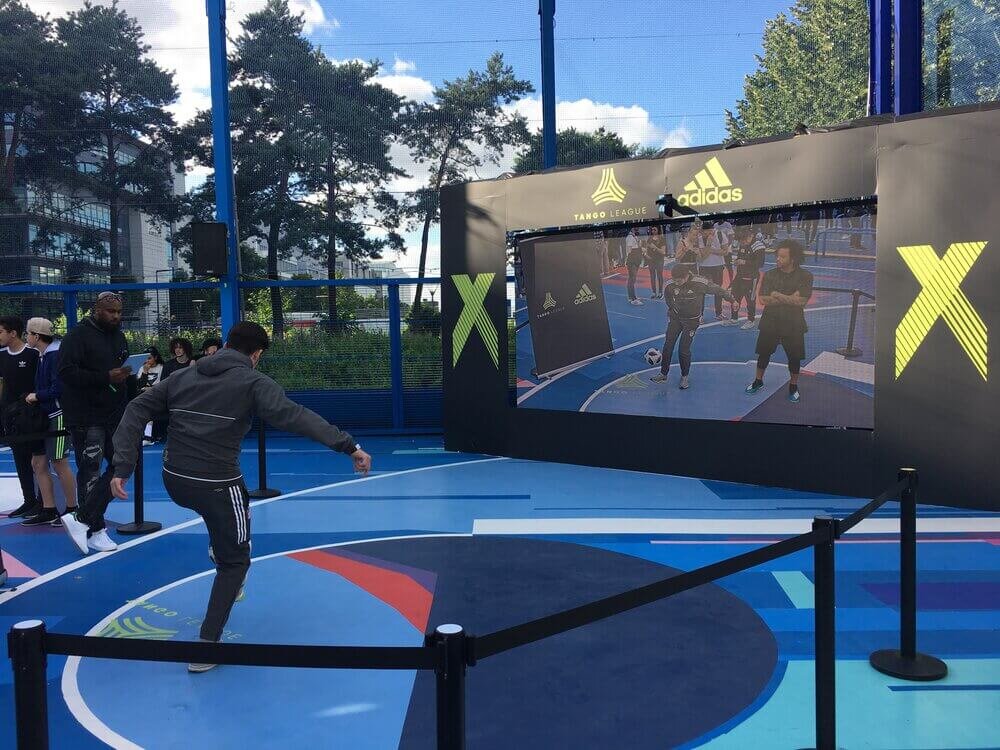
Some formats are built for scale rather than a single retail floor. Large-format, IP-driven installations are what brands and experiential agencies bring to live events, campaigns, and major sponsorships, compositing users with licensed sports, entertainment, film, and music IP in real time. The objective at this scale is audience engagement and content generation, not individual product try-on alone.
These activations tend to follow the same rhythm regardless of venue: a visual moment draws a crowd, the installation renders each visitor into the branded scene in real time, and the resulting photo or video is captured and shared before the visitor moves on. Touchless control, where a shopper's own phone becomes the remote, keeps the format staffless and cuts down on the friction of standing in line at a public installation.
First-party data collection
Underneath every format is the same underlying value: opt-in data. Interactions at an AI installation can be configured to feed a brand's existing CRM or ecommerce platform, turning a retail or event activation into a trackable, connected part of a brand's marketing infrastructure. For brands running physical retail alongside ecommerce, that closes a familiar gap between in-store engagement and the digital customer record.
Data captured at these installations belongs to the brand outright, rather than sitting inside a third-party platform's walled garden the way social engagement data does. Content generated at the point of interaction also behaves differently than a social post: it lives in a shopper's personal inbox rather than an algorithm-dependent feed, so it stays reachable and shareable well after the original activation ends.
Inside a Try-On Session, Step by Step:
A retail floor installation is only useful if the shopper understands how to use it without a staff member standing next to them. Here is what that sequence looks like in practice:
Initiate: The shopper starts the session using a touchscreen or their own mobile device, which keeps the format staffless and accessible.
Position: The shopper stands in front of the installation while computer vision captures their pose and proportions.
Select a Look: The shopper chooses from hundreds of curated looks or styles, rather than a single pre-set outfit.
Generate: Generative AI renders a photo-real image of the shopper wearing the selected look in about 20 seconds.
Receive and Share: The final image, along with additional look suggestions, is sent to the shopper's inbox, ready to post or revisit later.
Each step in that sequence also produces a data point for the brand, which is why the format functions as a marketing channel rather than an in-store novelty.
Virtual Try-On Drives the Strongest Return

Virtual try-on is where this spend tends to produce the most direct return for fashion brands. The format is built for retail floors, pop-ups, and experiential activations where the goal is product interaction, opt-in data collection, and content shoppers take with them.
A useful illustration is the multi-brand environment: at Oakridge Park in Vancouver, a single Vyu AI try-on installation ran styling activations for MaxMara, Lululemon, Thom Browne, Miu Miu, and Aritzia at the same time, with shopper engagement, content output, and CRM data collection running across five fashion labels in one footprint. A similar pattern shows up in touring retail: JC Penney's Vyu AI activation at iHeartRadio's Jingle Ball ran the same try-on format across five U.S. cities, and Doja Cat's wardrobe try-on at iHeartRadio's Music Festival paired the format with a music-fan audience instead of a retail one. For fashion brands and the agencies that build activations for them, that kind of multi-label environment is a strong proof point for the format.
How Fashion Brands Measure ROI From AI at the Point of Sale
Retail AI activations get measured differently than traditional marketing, with brands tracking dwell time, opt-in data volume, content share rate, and conversion rather than impressions alone. Content delivered through these installations sees roughly 87% average open rates and 95–97% email delivery, well above typical social or email benchmarks, where social feed engagement usually runs 1–3% and standard email marketing averages 20–25% open rates. First-party data ownership sits on the same side of that comparison: a brand owns 100% of what an AI mirror installation captures, the same way it owns email marketing data, while aggregated social platform data never fully belongs to the brand that generated it. Content lifespan follows a similar pattern. A social post lasts as long as an algorithm keeps surfacing it and a marketing email lasts until it is deleted, while an AI mirror image sits permanently in a shopper's personal inbox, reachable and shareable on their own timeline.
Brands running these installations don't evaluate the format the way they would evaluate a banner ad or a social post. The return usually shows up across five areas:
Conversion Rates: Virtual try-on gives shoppers a product interaction format a standard display cannot match, supporting the purchase decision at the point of sale.
Inventory Management: AI-driven try-on can ease physical garment handling and fitting-room demand on the retail floor.
Customer Engagement: AR mirror installations tend to hold shopper attention longer than static displays, and every interaction produces a branded, shareable output.
First-Party Data: Opt-in data collected at the installation feeds directly into a brand's CRM and commerce platform.
Environmental Impact: Fewer in-store returns also mean less reverse-logistics shipping, a modest but real consideration for fashion retailers weighing sustainable fashion commitments alongside conversion.

Virtual Fitting Rooms vs. AR Mirrors: How to Choose
When comparing virtual fitting rooms against AR mirror installations, the question that matters most is simple: what does the brand need the installation to do? If the goal is product interaction and conversion on the retail floor, a virtual try-on mirror like Vyu AI is the natural fit. If the goal is experiential engagement and content generation at a live event or large venue, an IP-driven format like HeroMirror or a large-format platform like BroadcastAR is a better match, and a mobile-accessible format such as MobileAR covers brands that want a WebAR or app-based experience without proprietary hardware. The formats are not mutually exclusive, and many brands run more than one depending on the campaign, the venue, and the audience scale.
A few practical factors narrow the choice further. A wall-mounted unit fits a permanent retail footprint, while a kiosk-based format suits a pop-up, a touring campaign, or a venue that needs the hardware to move between locations. A brand running one installation in one flagship store has different footprint and staffing needs than a brand running the same activation across five cities in a single month, and touring formats built for that pace tend to lean on touchless, staffless control rather than an on-site attendant. For a deeper side-by-side, see this virtual fitting room vs AR mirror comparison. This comparison page is part of the same content rollout as this post, so confirm it is live before publishing the link.
AR and AI Formats for Fashion Retail:
Fashion brands choosing between these formats are choosing between four builds, each suited to a different retail or event scenario. Here is what each one covers:
Vyu AI Try-On Mirror: Generative AI and computer vision try-on built for retail floors, pop-ups, and touring activations like the Oakridge Park and iHeartRadio deployments above.
HeroMirror: An IP-driven AR mirror kiosk that composites users with licensed sports, entertainment, film, and music IP for fan and brand experiences at scale.
BroadcastAR: A large-screen, cinematic AR format for venues and events where the audience and physical footprint outgrow a single kiosk.
MobileAR: App-based and WebAR experiences on iOS and Android that put AR in front of shoppers on devices they already carry.
Bring AI in Fashion Retail to Your Brand
Indestry has built AR and AI mirror experiences for fashion, sports, and entertainment brands since 2011, deployed in more than 50 countries. Get a quote today.
Frequently Asked Questions
How does a virtual try-on mirror work in a retail environment?
A virtual try-on mirror uses computer vision and generative AI to overlay a garment onto a live image of the shopper, with no physical garment handling required. The installation produces AI-generated images shoppers can share and collects opt-in data that feeds directly into a brand's CRM.
Can AR mirror installations integrate with a brand's CRM or commerce platform?
AR mirror installations can integrate with a brand's existing CRM or ecommerce platform by collecting opt-in customer data at the point of interaction. That turns a physical retail or event activation into a trackable, connected part of a brand's marketing infrastructure.
Do fashion brands measure ROI from AI activations differently than traditional marketing?
Fashion brands do tend to measure AI retail activation ROI differently than traditional marketing, tracking dwell time, opt-in data volume, content share rate, and conversion rather than impressions alone. Those metrics reflect the interactive nature of the format and map directly to CRM and sales outcomes.
Where do AI mirror installations perform best in a fashion retail environment?
AI mirror installations perform best in high-traffic formats where shopper dwell time already runs long, including flagship stores, pop-ups, and experiential activations at live events. Multi-brand environments, like the Oakridge Park deployment that ran five fashion labels at once, show how far a single installation can scale across brands.
What data can a fashion brand capture from an AI mirror activation?
A fashion brand can capture opt-in details such as email, age, and stated style preference, along with engagement metrics like dwell time and content share rate. That data belongs to the brand outright and can be routed directly into an existing CRM or ecommerce platform rather than staying locked inside a third-party analytics dashboard.